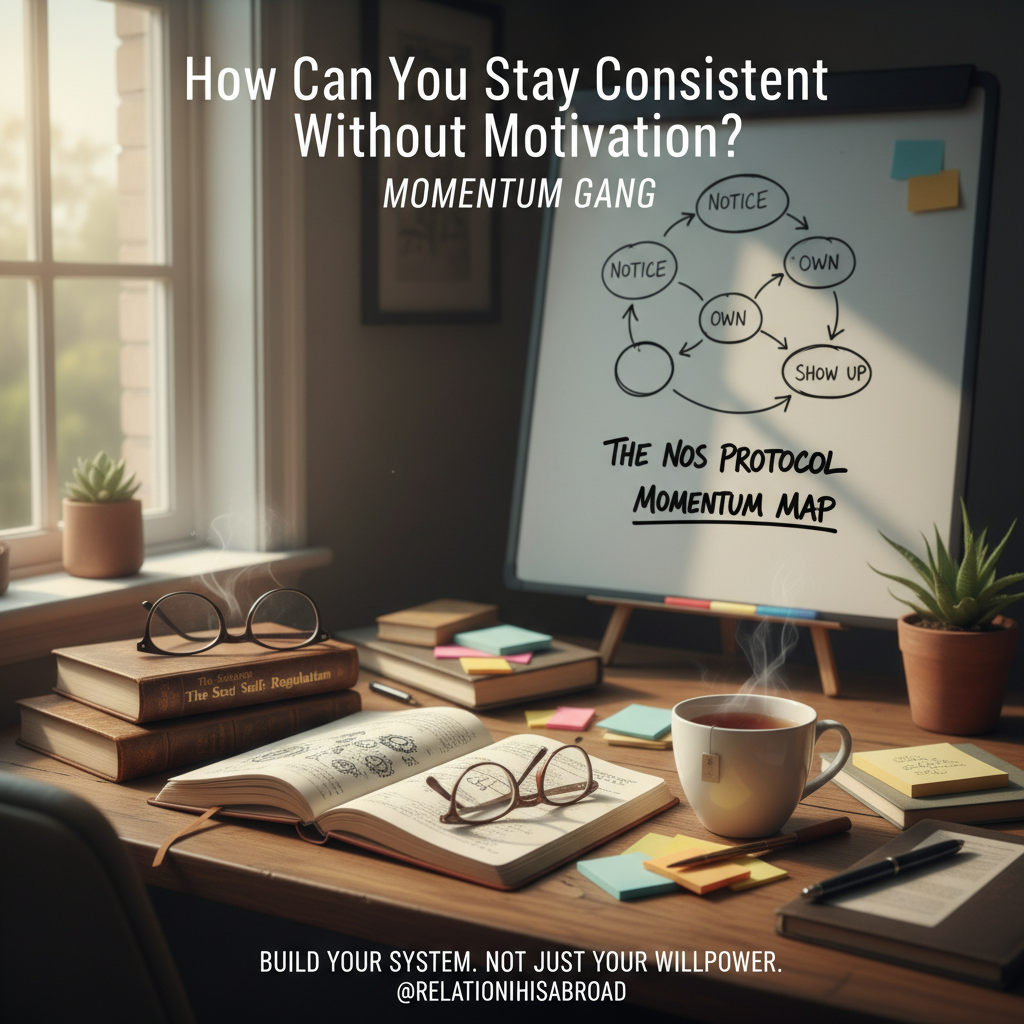
How Can You Stay Consistent Without Motivation?
You started. You were going strong. Then something came up, a deadline, a rough week, a single missed day, and somehow that one gap turned into two weeks of silence.
If that pattern sounds familiar, you are not alone. And more importantly, you are not broken.
The conventional advice is to "stay motivated," "find your why," or "build better discipline." But if that worked, you would not be here reading this. The real question is not how to generate more willpower. The real question is what conditions make it possible to keep going, and to come back, without needing to feel inspired first. That is what it actually means to be consistent without motivation.
Key Takeaways
- Falling off is not a character flaw. It is a design flaw.
- Motivation is unreliable by nature. Mechanics are what hold you when motivation disappears.
- The shame spiral after a gap does more damage than the gap itself.
- Re-entry needs to be so easy it feels almost embarrassing to skip.
- A personal momentum system, built around your real life rather than an idealised version of it, is what creates lasting consistency.
- Momentum Gang Level 1 is an 8-week structured container built specifically for people who keep restarting.
What This Article Covers
Consistency without motivation is not a willpower upgrade. It is a design upgrade. This article explains why motivation-based systems fail chronic restarters, what the research shows about willpower, how the shame spiral keeps you stuck, and how a personal momentum system, built around your actual conditions, makes consistent action structurally possible, even on your hardest days.
Who This Article Is For
This is written for ambitious rebels, introverts, scientists, founders, and creatives who keep losing momentum after the initial inspiration fades. If you have started the same thing more times than you would like to admit, tried habit tracking and found it made you feel worse, or suspect that "more discipline" is not actually the answer, this is for you.
Table of Contents
- Why Willpower Fails Chronic Restarters
- What the Science Actually Says About Self-Regulation
- What Actually Happens When You Fall Off
- The Mechanics That Actually Hold
- How Shame-Free Re-Entry Changes Everything
- What a Personal Momentum System Actually Looks Like
- Why Structure Without Pressure Is Not a Contradiction
- Conclusion
- Explore More
- Frequently Asked Questions
Why Willpower Fails Chronic Restarters
Motivation is a feeling. Feelings fluctuate. Basing a consistency practice on a fluctuating feeling is like building a house on sand and wondering why it keeps sinking.
The problem is not a lack of motivation. The problem is a lack of mechanics.
A mechanic is a condition, a design, a structure that makes the action easier to take regardless of how you feel on any given day. It is the difference between "I need to feel ready" and "the system makes the next step obvious."
You do not have a discipline problem. You have a mechanics problem.
What the Science Actually Says About Self-Regulation
Research on self-regulation consistently shows that willpower is a finite resource. It depletes across a day, across a stressful season, and across years of burning yourself down and rebuilding. For ambitious introverts and chronically restarting creatives, scientists, and founders, this is not a personal weakness. It is how the nervous system works.
What most productivity advice misses is this: designing for your most inspired version produces systems that collapse the moment life becomes real. The goal is to design for your least motivated day, not your most inspired one. When the structure accounts for reality, consistency without motivation becomes achievable, because the system no longer relies on you feeling ready.
What Actually Happens When You Fall Off
Here is the pattern that plays out for so many capable, self-aware people.
You start strong. The habit feels good. The project is alive. Then one day, you miss it. Life intervened, or energy dipped, or the motivation just was not there.
What happens next is the real problem.
Not the gap. The shame spiral after the gap.
"Why can't I just stick to things?" "I was supposed to be the smart one." "I started it again and gave up after three weeks. What is wrong with me?"
This internal scolding is not motivating. It is paralysing. And the longer the shame spiral runs, the harder re-entry becomes. The gap grows. The identity of "someone who cannot follow through" hardens. And the whole cycle resets, usually right around Monday.
I know this pattern from the inside. I was labelled gifted early on, the kind of kid who got through school without trying too hard, just paying attention and taking good notes. But by high school I was quietly depressed, hiding it from my mum because she was already stretched thin as a single parent. I graduated at 16 and withdrew from university at 18, not because I was incapable, but because I did not have the systems to follow through on the things I had started. I would get inspired, feel that surge of energy and clarity, and then watch it dissolve. The gap would grow. The shame would harden. And then the cycle would reset. It was not laziness. It never was. The design was wrong, and I had not yet figured out what the right design looked like.
Ziv, a Momentum Gang member, described it clearly: "I wasn't much of a completionist. I would start something, let it go, start something, never finish." Before working through the Momentum Gang framework, that pattern felt personal. After working through it, it was clear: the system was never designed for how he actually operates.
The shift from "I am broken" to "the system was wrong" is not a small thing. It is the entire reframe.
The Mechanics That Actually Hold
Consistency without motivation is possible, but it requires designing for your least motivated day, not your most inspired one.
This is the principle behind The Devotion Method, developed by Alex Feldman at Relationships Abroad. The method is not about forcing output. It is about understanding what conditions produce movement, and building those conditions into your day.
The operating loop is called the NOS Protocol:
Notice. Track your state without judgement. Energy, mood, focus, calm, meaning. Simple daily signals that let you see patterns over time instead of guessing.
Own. Choose the identity and season you are in right now, not the version of yourself you wish you were. Momentum is not one-size-fits-all. It shifts by life season.
Show Up. Return to the container, the group, and the next tiny version of the practice. Not the perfect version. The available version.
What this produces, over time, is a concrete picture of your drivers and drains. Not a theory. Evidence. And evidence is what builds self-trust.
How Shame-Free Re-Entry Changes Everything
Most consistency systems are built around streaks, check-ins, and accountability that functions as surveillance. Miss a day, and the system flags it. Miss a week, and it feels like failure.
Momentum Gang is built around the opposite assumption: gaps are part of the system, not a break from it.
This is not a soft reframe. It is a structural one.
When re-entry is built into the design, when it is treated as normal rather than shameful, the cost of a gap drops dramatically. The spiral does not take hold. You come back sooner. You trust yourself a little more each time you return.
Cam, a Momentum Gang member, put it this way: "Having time isn't as important as having energy." The system that works is the one that accounts for that reality, not the one that pretends you have unlimited reserves.
The group inside Momentum Gang reinforces this. It is not a performance space. Members do not need to report achievements or justify gaps. The act of showing up, even after an absence, is the practice. Visibility without pressure. Witnessing without judgement.
What a Personal Momentum System Actually Looks Like
A personal momentum system is not a morning routine from a business podcast. It is not a rigid habit stack or a colour-coded planner. It is a minimal, honest design built around three layers.
Foundation. The base conditions that make everything else possible, including sleep, nervous system regulation, and basic life stability. If the foundation is shaky, adding more habits makes it worse, not better.
Pillars. The practices that support your identity and season: exercise, meditation, writing, creativity, study, connection. These are chosen by season, not installed permanently.
Roof. The visible output, the business, the body of work, the project. The common failure is trying to build the roof while the foundation is cracked and the pillars are overdesigned.
When you can see which layer actually needs attention, you stop trying to fix the wrong thing.
Level 1 of Momentum Gang, the 8-week Momentum Accelerator, takes you through the full build of this system. By the end of eight weeks, members leave with a clear read on their drivers and drains, a Momentum Statement anchored to the season they are actually in, and evidence that re-entry is survivable.
That last part matters more than most people expect. Not inspiration. Evidence.
Why Structure Without Pressure Is Not a Contradiction
The version of structure most chronic restarters have encountered feels like control. Strict schedules. Non-negotiable streaks. Public accountability that turns into performance anxiety.
Structure that holds without constraining looks different.
It provides rhythm without rigidity. It gives you a container to return to, not a cage that traps you. It asks "what did you notice today?" instead of "did you hit your number?"
James, a Momentum Gang member, described two years of "just living on the one more month syndrome" before finding a structure that fit. "I'm just stuck in this never-ending cycle of trying to milk a little bit of time out of every week," he said. The problem was not laziness. It was trying to operate from a system designed for someone with a completely different nervous system, lifestyle, and set of priorities.
Consistency without motivation is not a willpower upgrade. It is a design upgrade.
Conclusion
You do not need to want it every day. You need a system that makes it easy enough to do even when you do not.
That is what Momentum Gang Level 1 is built to help you create. Not a generic productivity plan. A personal momentum system designed around your real conditions, your actual energy, and the version of you that shows up on a hard Tuesday.
The May 1 cohort is live. Enrolment closes April 29.
If you already know this is for you, secure your seat now at the Level 1: Momentum Accelerator page.
If you want to talk it through first, if you are not quite sure it fits, or you just want some support before deciding, book a GPS Navigational Call. It is a calibration conversation, not a sales pitch. You ask what you need to ask, and you leave clear.
Either way, the door is open. And re-entry is always normal here.
Explore More
If this resonated, these pages on Relationships Abroad are worth exploring next:
- Momentum Gang: The 8-Week Momentum Accelerator - The structured group container for chronic restarters who are ready to stop starting over.
- Free Momentum Masterclass: Maintaining Momentum - A free live session on how to design your life for your least motivated day.
- The Momentum Check-In (Free Download) - A 60-second daily tracking tool that reveals what is actually driving or blocking your momentum.
- 1:1 Coaching with Alex Feldman - Personalised support for navigating the patterns that keep getting in the way.
Frequently Asked Questions
Is it really possible to stay consistent without motivation?
Yes, but it requires a different approach entirely. Motivation is a feeling that fluctuates. Consistency built on mechanics, design, and shame-free re-entry does not depend on how you feel on any given day. When your system is built around your least motivated version, rather than your most inspired one, showing up becomes structurally easier regardless of mood.
What is the difference between accountability and a momentum system?
Traditional accountability relies on external pressure, someone checking whether you did the thing, often with social stakes attached. A momentum system works from the inside out. It asks what state you were in, what drove or drained you today, and what small design change would make return easier. The goal is self-trust built through evidence, not compliance driven by pressure.
Who is Momentum Gang Level 1 actually designed for?
It is designed for ambitious rebels, introverts, and chronic restarters who know what they want to do but keep losing the thread after the initial inspiration fades. People who resist rigid accountability, struggle with shame spirals after gaps, and need structure that holds without feeling like control. It is not designed for people seeking strict enforcement or high-volume content consumption.
What happens if I fall off during the 8 weeks?
Re-entry is built into the system as a normal part of the process, not a failure. The group normalises gaps. The method accounts for them. If you fall off, the container is still there when you come back, no explanations required, no shame attached. That is the whole design.
Author Bio
Alex Feldman is a scientist, researcher, and coach at Relationships Abroad. He holds a P.S.M. in Applied Biosciences from The University of Arizona and has held research positions at Kyushu University, The University of Tokyo, and Chiba University. He created The Devotion Method and the NOS Protocol after his own experience with depression, burnout, and shame spirals, and now guides ambitious rebels through the same reframe.
If you want support building your own momentum system, explore Momentum Gang Level 1 or book a GPS call.